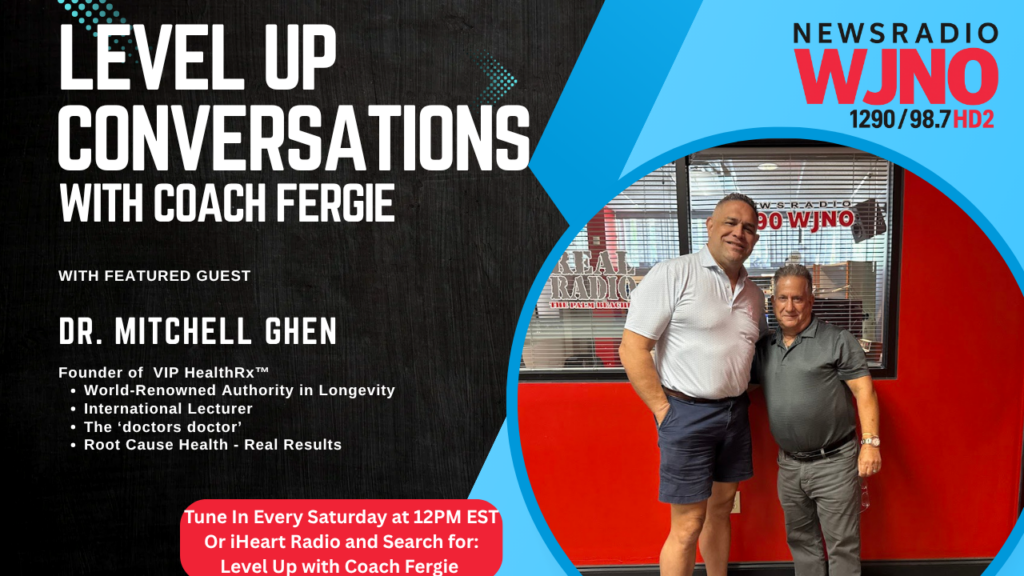
Dr. Mitch Ghen, D.O., Ph.D., is a globally recognized leader in functional, integrative, and longevity medicine with more than 44 years of clinical experience. Founder of Ghen Medical and VIP HealthRx™, he specializes in root-cause medicine, regenerative therapies, stem cell transplantation, hormone optimization, and advanced nutritional medicine. An author, educator, and media personality, Dr. Ghen has published extensively, trained thousands of healthcare professionals, and hosted nationally syndicated radio and television programs focused on health and wellness.
Coach fERGIE’S tOP 5+ Knowledge Nuggets and Take-Aways
- Stop treating symptoms and start investigating root causes—the real answers are usually deeper than the diagnosis. 🔍
- True longevity is not about adding years to your life—it’s about adding life to your years. ⏳
- The best healthcare begins by asking, “What is your biggest expectation?” not “What medication do you need?” 🤝
- Blood work should tell a story, not just provide numbers. 📊
- Your thoughts influence your physiology more than most people realize. 🧠
- If you’re constantly living in fight-or-flight mode, eventually your body will send you the bill. 💳
Recommended Resources – Hover and Click
🔥Show Sponsor Steve Austin’s Dynamic Team with Rize Mortgage
Please Consider Supporting the 988 Suicide and Crisis Hotline
- 🔹Valuable Time-Stamps 🔹
- 🕒 04:00 – Why Personalized Medicine Matters
- 🕒 07:45 – Finding The Root Cause
- 🕒 10:15 – Quality Over Quantity Of Life
- 🕒 19:15 – Stress, Mindset & Health
- 🕒 24:45 – Making A Difference Daily
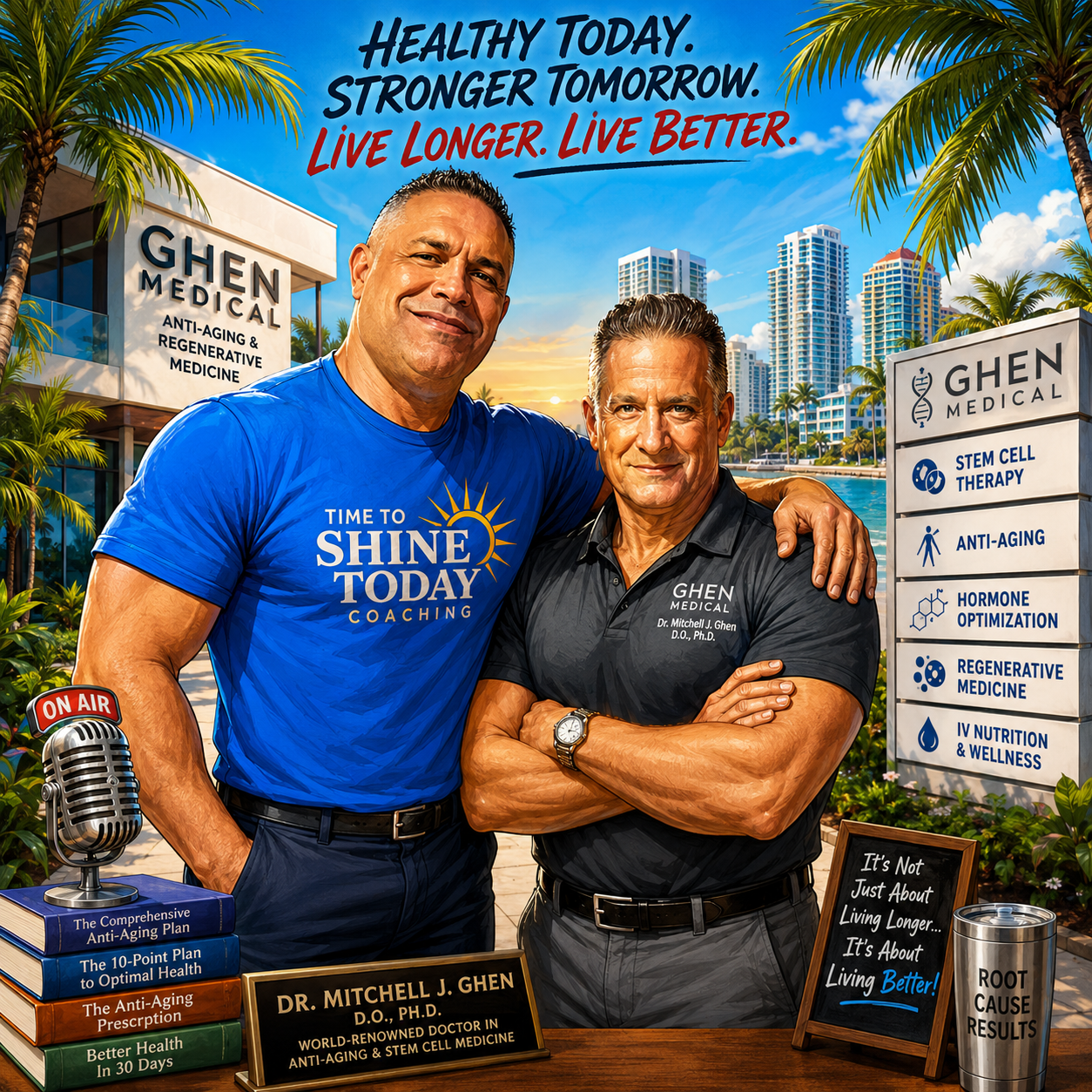
Artwork by Dylan Allen
Videography by Aubrey Aerials Marketing, LLC
Speech Transcript
L. Scott Ferguson: Hey, Varsity Squad. Welcome back to another powerful edition of Level Up conversation with Coach Fergie with Time to Shine Today Coaching. I’m your host, Scott Ferguson, blessed to be your gap coach, specializing in performance mental conditioning, working with business leaders, entrepreneurs, entertainers, athletes, C-suite, and students to help them bridge their success gap to live a life of options, not obligations.
On this platform, we are stoked to bring you high performers who are not just chasing and attaining success, but redefining it through providing above and beyond service. And squad, real quick knowledge nugget. We spend so much time thinking, talking about goals. I wanna lose 20 pounds. I wanna make more money. <<READ MORE>>
On this platform, we are stoked to bring you high performers who are not just chasing and attaining success, but redefining it through providing above and beyond service. And squad, real quick knowledge nugget. We spend so much time thinking, talking about goals. I wanna lose 20 pounds. I wanna make more money. <<READ MORE>>
I want better relationships. I want to grow my business. But here’s the problem. Goals are nice. Standards are what actually get you there. Remember, I always say that goals are nothing but byproducts [00:01:00] of your standards, squad. I was talking to a restauranteur that I coached recently. Great guy, smart, driven, good heart, but he was frustrated because the business wasn’t growing at the pace he wanted.
So I asked him, “What are your standards? Not your goals, your standards. How often are you meeting with your team? How often are you reviewing your numbers? How often are you working on the business instead of just in it?” See, everybody wants the championship trophy. Very few people want championship standards.
The people who win don’t magically become disciplined when they feel motivated. They establish standards when motivation is nowhere to be found. Here’s what I’ve learned coaching entrepreneurs, executive athletes, and high performance squad: your future is hidden inside the standards you tolerate today.
Not your vision board, not your affirmations, not your intentions, your standards, because standards remove negotiation. When the standard is a standard, you don’t ask yourself if you feel like doing it. You do it because that’s who you are. Stop asking yourself what your goals are. Ask yourself this: What standards am I living by?
‘Cause your standards determine your future far more than your goals ever will. And squad, talking about standards, gotta give a huge shout-out really quick to Emily Pantelides, PR Consulting. She really came [00:02:00] through for me. Her awesome sauce, Caitlin, is in studio as well today too. Joining me today is a true pioneer in the world of functional, integrative, and longevity medicine, Dr.
Mitchell G. Gayed, better known as Dr. Mitch. We’re talking over four decades in the trenches of root cause medicine, four medical textbooks, thousands of patients treated, and a reputation as the physician other physicians turn to when they want to understand what is real in health, healing, and longevity.
His work spans hormone optimization, IV nutrition, regenerative medicine, stem cell transplantation, advanced lab interpretation, inflammation detoxification, gut health, and the science of aging from the inside out. Dr. Mitch has trained thousands of doctors and practitioners, lectured internationally, hosted nationally syndicated radio and television shows, and continues to cut through the noise in a world filled with quick fixes, biohacker hype, and one size fits all.
So today, we’re gonna unpack what it really means to live longer, stronger, clear, and more vibrant, not by chasing trends, but by understanding the body, finding the root cause, and giving it what it needs to heal. And squad, I gotta tell [00:03:00] you I was told by the PR rep that, Emily, that his age, and I had to verify it.
And you’re gonna watch. Go to YouTube and watch this guy right now. He’s 76 years old, absolutely handsome dude with just fantastic shape, and he said that, he has to look the part if he’s gonna be talking the part. So thank you so much for coming in the studio, Dr. Mitch.
Dr. Mitchell Ghen: Oh, coach, it’s a pleasure.
L. Scott Ferguson: Worked with everybody from, everyday patients to physicians, high performers. What’s the biggest health mistake smart, successful people make because they think they’re doing the right thing?
Dr. Mitchell Ghen: They watch too much YouTube and things of that nature. Yes. Yeah. It’s a problem. We have people that now wanna attach a title to them, so they go onto YouTube, they become a biohacker, they become this and that.
Steve Austin (Show Sponsor): Right.
Dr. Mitchell Ghen: The truth is we’re very complex. We’re trillions of chemical reactions per second. Wow. So to be able to understand that, to really help someone to age properly, be healthy, and reach optimal health, you have to look at two specific areas. One is the biochemistry of that individually [00:04:00] individual, and the other is the physiology.
How does that person function? And the biochemistry has to be developed deep enough to really get a good understanding, not the typical maybe a, a blood count and a metabol- You have to really dive into that individual with a, like you would with a car. Years ago, you already mentioned my age, so I can say- Yeah,
L. Scott Ferguson: I’m sorry.
I- I’m blown away. It’s
Introduction: amazing.
Dr. Mitchell Ghen: If,
Introduction: thank
L. Scott Ferguson: you. My, my dad is 78, and I, he looks great for his age. But like you, you’re 76, just amazing, man. Well- So that’s great …
Dr. Mitchell Ghen: thank you. I appreciate-
L. Scott Ferguson: I’m trying to follow. I’m 54, and I’m like, “This is goals-”
Dr. Mitchell Ghen: Well- “…
L. Scott Ferguson: right now” …
Dr. Mitchell Ghen: hopefully I’ll help you follow in that pathway.
There you go. But I always talk about, years ago when I talk ab- when you had a car, what’d they do? They looked under the hood. They checked your carburetor. They took out the oil filter and oil lubed your car. That was it. Nowadays, you take your car in, they hook it up to 155 check.
Steve Austin (Show Sponsor): Yes.
Dr. Mitchell Ghen: And that’s what I do.
I’m looking for that 155-plus check about your biochemistry because just taking a pill over here or a pill over here, it [00:05:00] may have some good proclivity to help someone. On the other hand, though, it may be doing something not as good, and why not optimize? Why not be the best you could be? That’s what you teach, Coach.
That’s what I do.
L. Scott Ferguson: Absolutely. And so d- I have to ask you, does the blood work tell you a lot of the story w- with regards to physiology and the biochemistry? Do you start a lot with the blood work with your patients and tell the story, or what is some of your protocol? I actually took your online quiz last night and stuff.
It was a lot of fun and- Good … but just curious, how do you get the protocol started with clients, with patients?
Dr. Mitchell Ghen: The very first thing I do, and you can call, some people call them clients. Sure. They, I don’t care. People can call me Mitch or anything, it’s okay. The bottom line is how do I determine who I’m talking to?
First, of course, I listen to them for a long time and try to figure out what it is that they are expecting. I always ask, “If I could do anything for you, what would be your major expectation?” Once I have that, I always will do a deep dive into someone’s blood work. That is a good review, [00:06:00] and it pretty much illuminates their biochemistry.
The second thing I do is I often look at a functional test, specifically at the autonomic nervous system. The autonomic nervous system, which you’re probably extremely familiar with, Coach, you have to control that system because- Nine out of 10 deaths either initiate or complete in that system- which is that fight or flight versus the rest and digest. Sure. I go into it if you want more, but basically those two areas allow me at least to sit down with someone and say, “Here’s where you’re at. Here’s your footprint. Now, what can we do to improve it?”
L. Scott Ferguson: That’s, y- Scott, did you hear that? He said, “What is your major expectation?”
A lot of time you go to the doctor, they’re just gonna throw something down your throat, right? They’re gonna be like, “This is what you need, and see you next time.” I’m blessed to get free medical from the VA, right? And I lu- luckily lately my latest kind of primary physician, she’s actually really into fitness and really into kind of longevity and stuff.
She actually take, looks at me and is “Okay, I wanna work with you.” With the, like [00:07:00] leveling up my life. But before it was just like cattle, pew. Yeah. Shut through. So that’s just phenomenal that you’re asking them what their expectations are, and you don’t hear that a lot. You just don’t from doctors.
Dr. Mitchell Ghen: Yeah, I don’t think most doctors have the time. Their time i- is seven minutes typically- Yes, sir … with an individual patient. We spend anywhere from 30 minutes to 45 minutes as an initial interview. But of course, it’s not about what I want for you. Look, I want you to be the healthiest, I want you to be perfect, I want you to be optimized.
The truth is that’s maybe not what you want. You may be, “Mitch, all I want you to do is fix blank.” So I don’t attach ego to the treatment. I attach the best treatment to that individual and their needs.
L. Scott Ferguson: I love that. And you talk about treating the root cause instead of the symptoms.
Yes. Which I love that. So what are the biggest blind spots you’re seeing in modern healthcare that keep people sick longer than they should be?
Dr. Mitchell Ghen: Modern healthcare is based on an if-then concept.
L. Scott Ferguson: And I’m not trying to rip on modern healthcare. We all need it. But I’m just-
Dr. Mitchell Ghen: No …
L. Scott Ferguson: again, going back to what I said earlier.
Dr. Mitchell Ghen: And I agree. I’m not [00:08:00] going to throw the a baby out- 100%, yes … with the water. I, but let’s look at it clearly and at, let’s make sense to both of us. Yeah. Number one, we work in the Western model in an if-then. If you get a symptom, we’re gonna give you something. If you have high blood pressure, here is this.
If you have… That’s not really the best way to work with someone. The answer or the question should be what you asked me. What’s the root cause? You didn’t have high blood pressure when you were 18- … let’s assume. You have it now. The question is, why? Too often in the regular medical community, it’s a wave of the hand.
“Hey, coach, you’re getting older.” I never say that. I look for what happened. Is it that lining, that endothelial- Yeah … that one cell lining that lines the 65,000 miles of our circulatory system that may be going bad, which it is often. In other words, what is causing this? Or is it something different? And that’s how you replete that particular individual, both through the biochemistry and the functional abnormalities- Oh
to create what was- So good … the, what was mis- what was wrong in that root cause issue.
L. Scott Ferguson: That’s so good. [00:09:00] 100%. And longevity has become a billion dollar, industry between biohacking, peptides, supplements, stem cells, hormone optimization. What out there are you seeing that really actually moves the needle the most?
Dr. Mitchell Ghen: The thing that moves the needle the most is what your body most needs. And I don’t know how to s- Love it.
L. Scott Ferguson: It’s, everyone’s different. Thank you, man.
Dr. Mitchell Ghen: We are- Yes … I used to say, and I don’t know if this figure is absolutely correct, but it’s probably fairly close. We’re over 868 trillion chemical reactions per second.
To say what you need is the same as Kaylin or Brian needs, or anybody else out there, would be naive, and it doesn’t even make any sense. We need to really determine that individuality, and I give you a very good example. We have one to 10 insults to double-stranded DNA a, a day. Now, we have 30 to 37 trillion cells.
Insults? Insults- Okay … that actually damage or can damage that double-strand DNA. Got it. It only takes one to start to produce a cancer. Cancer, yeah. W- [00:10:00] taking the this one thing or taking it once a day, what happened to the other 23 hours in the day? Why are we not taking care of that individual over the course of the day to make sure that the body and the cells are working at their optimal, but not five minutes, but 24 hours a day?
And y- what you need may not be what I need- … certainly not what Kaylin n- Sure … we are all different. And so the answer to that question is, you need to find out who you are, basically, from a standard of cellular medicine to be able to determine how to become a longevity-type person. And it’s not just about length, by the way, and I’ll be, gonna tell you a story.
I don’t know how much time we have, but it’s really about quality.
L. Scott Ferguson: Okay.
Dr. Mitchell Ghen: Quality’s the key. You wanna hear this story? Yeah. Yes. I’ll do it in one, in 60 seconds. I’m on a plane one time- 60 … sitting up in first class- … going to lecture in Los Angeles, and sitting next to a very well-known guy. He had 50,000 employees when he sold his company, doesn’t matter.
And he’s going to a Tesla conference, and I said to him, “By the way, come, some of my engineers told me [00:11:00] that the large battery could be doing damage because of the magnetic field to your body.” Your body. To your body. Not that I put that aside, because I have a Tesla now, so I don’t want Tesla to be mad at me.
But I s- he said to me, e- he tried to write to the, as we took off, he was writing to the engineers. They never answered. About an hour into the flight, he looks at me, he says, “You know what, Mitch? My, I have a great cardiologist in Boca.” And he said, “So what if you had a great life if you miss, even four years of it, but you had a great life?
W- isn’t that amazing?” I said, “You know what?” And I’ll call his name Sam just for the sake of the conversation. Sure. I said, “Sam, let me just give, reframe your thinking for one minute.” He goes, “Okay, Mitch, what is it?” I said, “Okay, we’re in this plane. God comes on this plane right now, comes, just walks up to you and says to you, ‘I’m giving you two choices and only two choices.
One, you can have 10 perfect years of life, and I’m taking you in your sleep at the end, or 50 years miserable with a f- a feeding tube and someone will have to toilet you and stuff.’ Which one do you take? You got five seconds.” He goes I take the 10-” And as he said the 10, he looked at me [00:12:00] and goes, “I understand now, Mitch.”
Yeah. I said, “That’s right. It’s about quality. Quantity will follow. It’s about making you the best that you could be today,
L. Scott Ferguson: coach.” The next 10 years is gonna, like bank and bank, and the deposits you’re making, you’ll be able to withdraw from that if you start.
Dr. Mitchell Ghen: Ex- exactly.
L. Scott Ferguson: Love that. And squad, we are gonna throw it to my sponsor Steve Austin with Rise Mortgage, who I’m blessed to have.
When we come back, I’m going to go through maybe like a protocol of when a patient walks in Dr. Genn’s office. So Steve, take it away
Steve Austin (Show Sponsor): Thanks, Scott. Happy Saturday, everyone. This is Steve Austin with the Rise Mortgage Dynamic Team with your mortgage tip of the week. If there’s one thing I’ve learned over the years, it’s that a key differentiator in successfully navigating the home buying process is the team of professionals you have working for you.
As the housing market heats up, don’t lose out on your dream home because you don’t have the right team on your side. To learn what you should be looking for in a team of experts you hire, give us a call at [00:13:00] 561-250-6044. That’s 561-250-6044. That’s the tip for this week. This is Steve Austin, your branch manager, NMLS 762328 with the Rise Mortgage Dynamic Team, NMLS 1604663, an equal housing lender.
Advertisement: Are you looking to finance your dream home, vacation getaway, or an investment property? The Rise Mortgage Dynamic Team and Company is here to help. Steve Austin and his team, their expert loan advisors, combine local knowledge with cutting-edge technology to make your financing process efficient and seamless.
Whether it’s your first home or your next investment, trust Steve Austin and the Rise Mortgage Dynamic Team and Company to guide you every step of the way. Visit them today and experience the perfect blend of technology and personal touch. Steve Austin’s Rise Mortgage Dynamic Team, your local experts in residential financing.
Call Steve today at 561-352-9278. That’s 561-352-9278. 561-352-9278. NMLS number [00:14:00] 1604663.
L. Scott Ferguson: Hey, thanks so much, Steve, for the m- mortgage nugget in the update. I’m so blessed to have you as a sponsor. And again, we’re back here with Dr. Mitchell Gen. And Doc, let’s say you’re kinda going through the protocol. Someone’s in your office. You’ve found their blind spot. They’re what we’re gonna start going after right now, and then they’re still making sure you’re the right horse for the course to be their doctor, right?
So is there any good question that you wish they would ask you but never do?
Dr. Mitchell Ghen: I think pretty much most people ask me every question, and that itself is a good question. I think the question they should be asking is, “How do you approach this differently?” And even if they don’t ask that- … I tell them.
Love it. And I also show them, I see the sick of the sick from pretty much all over the country and world come to see me. I see [00:15:00] cancers that are failing. Most of the cases that I take are s- cases that have been very difficult for major institutions and for other physicians, because I take a very different view.
I’m going to, as I, we talked about earlier, I’m gonna look at that root cause. I’m gonna try to get to what went wrong. And I always tell someone, “If you really wanna know what’s going wrong, you have to be able to look at the cellular mechanisms.” And when I teach, I always, for example, show the Krebs cycle.
You may b- remember this. I remember it, yeah. And, yeah, when, from school. It’s a complex cycle, but if you look at it clearly, you’ll see there are no medications in that cycle. There are no i- instruments in that cycle. But magnesium is. Essential fatty acids, manganese all these things-
L. Scott Ferguson: P3, K2.
Dr. Mitchell Ghen: It’s all there.
Something like that, right? Yeah. It’s all there that makes it work. So I’m… look, I see myself as a vessel of God. I always have. Love that, man. I’m in the… you could talk mind, body, spirit. I live mind, body, spirit. I went ahead. I did my own rabbinical degree. I wanted answers.
And I [00:16:00] realized that if you wanna be mind, body, spirit, you need to bring all that to the equation. You have to realize there’s something greater than you. And if God put something there for a reason, and that’s the equation, why did, why do we have these things to make ourselves work right? That’s probably what we really need.
And that’s true. It ends up being very true.
L. Scott Ferguson: It… And a lot of my clients, they- And tell them they’re sinning if they’re not living up to their ultimate potential. And I re- and I tell them it’s not a religious kind of context, right? But like- Of course … sinny is the root word, Greek word, root word for missing the mark.
It comes from a- archery, right? So like you’re missing the mark. So I get them to laugh a little bit “You know you’re sinning against yourself,” right? And then they start to get it. But that, at what point should people stop accepting the fatigue, the weight gain, the brain fog, the poor sleep, low libido, as just getting older?
When do you think that… I mean- Never … everyone’s… Thank you. Thank you. Thank you.
Dr. Mitchell Ghen: Never. It’s, if you really wanna be yourself you can always resolve to do and let fate and things take its c- course. I don’t believe that. [00:17:00] Coach, I know you don’t believe that. It’s, you have to take the hor- the bull by the horns today and make a difference.
It doesn’t matter- … if you’re 18 years old or if you’re 80 years old. If you change that biochemistry, that physiology, you’re going to be the best you can be as of today. And why wouldn’t you want to be the best? Sure. It doesn’t make any sense. We’re given certain things. We’re here to have a pleasure, to enjoy life, to have people, social interactions, and be as healthy as we can be.
We have a right, we have a privilege, and we must take care of our bodies.
L. Scott Ferguson: I love you say that ’cause we- We’re the only living species that I can think of that limit ourselves. You look at anything else that grows a root of a tree is gonna tell the tree how it can grow, right? A lot of people will say that dog’s fat.”
Usually the owner’s not walking it, right? So i- it’s like we are the only ones that don’t go to the next level or try to push that because God gave us the ability to think. When you kinda get into the mindset, into my world of stuff with them, like, how does that kind of [00:18:00] conversation go when, in keeping them on protocol, moving forward with your system?
Do you have a follow-up system with them, or is it completely up to them, or how does that work?
Dr. Mitchell Ghen: It’s sorta bi-directional. We make sure that I make an appointment to see someone and follow up as often as I think needed. For example the more complicated their criterion for what they’re looking for, the more often I’ll see them and have them come in.
And, I always go over their program when they walk in. “Are you taking, are you d-?” Yeah it’s one of, you know- I wanna
L. Scott Ferguson: know how you handle that. Well- Because it, it seems, you’re from Philly, right?
Dr. Mitchell Ghen: I am. I’m from Philly.
L. Scott Ferguson: Like if someone’s not doing something. I’m a Philly.
Dr. Mitchell Ghen: They- I te- you know. I do this. When they tell me- Yeah … I ChatGPT’d th- this,” I tell ’em, “I’m ChatGPT 12.9.” “So first of all, don’t listen to it. I know it better than that does.” Yes. Thank you. And that’s the first thing I say. The second thing I say is, “Look, it’s over, op- openly your choice.
I wouldn’t waste money seeing me if you’re not going to listen to what I wanna help you with. But you can call. You can leave a message. You can ask me. I know what works and what works not together. I will tell you why I [00:19:00] did something. But if you really want, it is you need the other side to work with you.”
Sure. “I can’t tell you to take three vitamins, and walk, and do, and, think a certain way. You have to bring it all together.” It’s a combination of five things or six that I always talk about. You have to have cellular nutrition. These are mutually inclusive. You have to have a certain amount of crosstalk.
That’s hormonal. You need to have certain energy, ’cause the cell has energy, acupuncture, chiropractic, so forth. You need to have some sort of detoxification. Not that I’m detoxing today, ’cause people don’t know what that means, but some sort of things that we can get out. And then, and the one that’s also mutually inclusive is what I call psychosocial s- socialization.
Basically, psychoneuroimmunology. What do you think? Because you could have all four of the other things, perfect nutrition, everything else. Coach, you know this. If that person comes in, you go, “How do you feel today?” “Eh, that person- Has just as much chance dying as someone that smokes- Yeah
like two packs of cigarettes a day for the next 11 years. So it’s important to, [00:20:00] to have all that one time. Go ahead.
L. Scott Ferguson: The psychoneuroimmunology, it’s studying the relationship between the mind, nervous system, and immune system. Is that correct? That’s correct. Okay. So how much of chronic illness today is connected to that stress mindset and emotional health?
Dr. Mitchell Ghen: A huge amount. What you think is what you get. Yeah. And-
L. Scott Ferguson: 100%.
Dr. Mitchell Ghen: And the truth is you look at the studies on cancer and you look in this, you took, look at someone who has cancer. The person who has the least amount of cortisol released, the one that says, “I’m gonna beat this, doc. I’m in it. I can do it,” does much better.
As a matter of fact I’ve read study that showed that, women that have a massive amount of cortort- cortisol released, they have 30 times the amount of metastasis than someone else that doesn’t. I would
L. Scott Ferguson: believe that 100%. Yes.
Dr. Mitchell Ghen: Stress makes it all different. Yes. Why are there studies that say in summer you do better if the diagnosis occurs in summer for the same disease even though you might’ve had it before?
Because of the sun? Maybe, but more importantly, people then start to look at their life saying maybe it’s time to go to the beach. Maybe it’s time to relax.” Yes. [00:21:00] Maybe it’s time to put things- Lifestyle … into perspective- … that are really important. The, what I try to encourage is put things into perspective early enough- Sure
so you can have a great life and you can, feel good and look good. And I also sometimes say, if I can say it, have great sex- Yeah … ’cause those are the things that people want.
L. Scott Ferguson: That’s a, it, 100%, it’s, we’re humans.
Dr. Mitchell Ghen: Yeah.
L. Scott Ferguson: Marriage, and that’s part of that thing, right? Of course. That God gave us.
If you could run one advanced test on every American tomorrow or anybody i- in the world, what do you believe we would discover about the true state of our health?
Dr. Mitchell Ghen: It’s in big trouble
L. Scott Ferguson: Okay.
Dr. Mitchell Ghen: The truth is if you ran, for example, if you said, “Mitch, pick one test that you would do that’s, a machine of some sort,” it would be the autonomic nervous system.
Non-invasive, 30-minute test. Through that, I can tell you the health of your heart rate variability. I could tell you whether or not you’re stressed into the ground. I can tell you whether or not you’ve already created a micro sc- a, a micro, a circulation disorder. Very nice because if these tiny little vessels are already in trouble from chronic [00:22:00] cortisol bathing- there is no bypass. It’s smaller than a hair. Chronic
L. Scott Ferguson: cortisol bathing.
Dr. Mitchell Ghen: Yeah.
L. Scott Ferguson: Wow. Okay.
Dr. Mitchell Ghen: Yeah. And if you can look at these things and begin to work on that, I’m gonna tell you that if I will do 1,000 people, 900 of them, in my opinion… Now, it’s a made-up number. I just said it. Yeah. But in my opinion, that’s, it would for certain be that many that have that dysfunction already in that system.
Because look, we all have that fight or flight system. Yes. We want that fight or flight system. It saves us. But instead, we push it all the time. You have a car. You may have a- You live in it. You live in it. Yeah. You could have a great car. You can’t tell me one car, German, Japanese, they’re great cars.
Put your foot to the floorboard and tell me what happens at the end of the day. It’s gone. We put the foot to the floorboard, and because God’s made us like a good seal on the forest that’s can bend, we tolerate it.
L. Scott Ferguson: Right.
Dr. Mitchell Ghen: But how long? Got it. Sooner or later, that person’s gonna end up with some chronic disorder.
L. Scott Ferguson: 100%, yes. That’s
Dr. Mitchell Ghen: it.
L. Scott Ferguson: How about quickly on this one though, like, all [00:23:00] these- Fitbits and, Hum Bands and Whoop bands and stuff that are, they’re fitness trackers disguised as medical devices I’m seeing a lot right now. What is your thoughts when then people say, “Oh, my thing says, re- reads this?” So like-
Dr. Mitchell Ghen: Yeah I don’t use, coach, any of them myself personally.
Okay. Nor do my wife. That’s cool. I’ll go to the problem first. They have some very nice information, I would think. The problem with this is it makes someone paranoid and live by it. The- … person that takes their blood pressure 14 times a day- Yep … their blood pressure’s going to be elevated.
‘Cause blood pressure changes every five minutes. Sure. The one that seems to give me, w- that I read anything would be the Hum Band. Thank you, Hum Band. Yep. I told, said it. But- Just
L. Scott Ferguson: ordered mine, yes.
Dr. Mitchell Ghen: Yeah, okay. Okay, it’s g- because it has heart rate variability. Yes. And heart rate variability, which most people don’t understand, makes a huge difference, ’cause that is the response of the sympathetic, parasympathetic- Right
nervous system balance.
L. Scott Ferguson: It’s that gap between the heartbeat, right? Like the heartbeat, gap, that’s your HRV?
Dr. Mitchell Ghen: I’d, I’ll explain it a one second different, I think, for you. Normally, when you look [00:24:00] at, watch a movie and you see the EKG going beep. Yeah. And we say, “Oh, that’s good. It’s regular.”
Someone with a good heart rate variability or a good heart that’s working very well, there’s a m- millisecond difference between beep, every beep.
L. Scott Ferguson: Yes.
Dr. Mitchell Ghen: Now, we require that, ’cause that’s the flexibility. When it becomes stiff, that’s when the person’s in trouble. That’s when they’ll end up with a dysrhythmia that could be- Right
of course, very serious. Gotcha. So the heart rate variability will vary according to the day, according to your stress level, but the idea is to keep it most of the time within the normal limits or learn- … how to use your c- coaching skills to help someone- Yeah … focus so they can bring
L. Scott Ferguson: up- I hook them up to HeartMath and we take a look at it, yeah
same, it’s a
Dr. Mitchell Ghen: s- well, HeartMath is heart rate variability. Yeah.
L. Scott Ferguson: Yes, exactly.
Dr. Mitchell Ghen: Yeah.
L. Scott Ferguson: I love it, and r- I can’t believe how fast time is going, but I have to ask you my canned question here, okay?
Dr. Mitchell Ghen: Okay, go ahead.
L. Scott Ferguson: Like how does Dr. Den want his dash remembered? That little line in between your incarnation date and your expiration date.
Hopefully it’s still way down the line, but how does, how do you want your dash remembered?
Dr. Mitchell Ghen: First, thanks coach, [00:25:00] for that way down the line, ’cause that- Yes … na- that’s good when you say that. We
L. Scott Ferguson: need
Dr. Mitchell Ghen: you, man. Yeah, I’m gonna do my best. The answer to it is- The same thing I always say. Did I make a difference for humankind at the end of the day?
Yeah. Did I change and touch the lives of people where other doctors, other institutions couldn’t do? And I often say, “When I go to bed at night, what’s my purpose of getting up in the morning?” I look at the day as I review it before, as I say my prayers when I go to bed. Did I make a difference for even one person that makes a massive difference that made them healthier and optimized their health?
If it’s yes, I go to sleep, I get a great eight-hour sleep, and I wake up with a prayer and purpose to go on again.
L. Scott Ferguson: I love that. Just living intentionally. And squad, I need you right now to go to ghenmed.com, G-H-E-N-M-E-D.com. Again, G-H-E-N-M-E-D.com. And there is… He offers a little quiz, if you will. Get on there. I did it last night.
Literally, it says three minutes. Took me three minutes. It [00:26:00] was awesome. Thank you. Talk to you again. We’re gonna bring you back. 100% we’re bringing you back- … ’cause I need, I have other questions we can go through. But I wanna thank you for coming in. Thank you so much. My pleasure. Thank you to my awesome producer, Brian Mudd, to WJNO, to Kaylin for setting this up, and also my awesome sauce friend Emily Pantelides from Pantelides Public Relations.
Squad, good shout-out to my troops, fellow troops out there doing the deed. Please all be safe. Love your guts.
DISCLOSURE: I may be an affiliate for products and resources that I recommend. If you purchase those items through my links I will earn a commission. You will not pay more when buying a product through my link. In fact, I often times am able to negotiate a lower rate (or bonuses) not available elsewhere.
Plus, when you order through my link, it helps me to continue to offer you lots of free stuff. Thank you in advance for your support