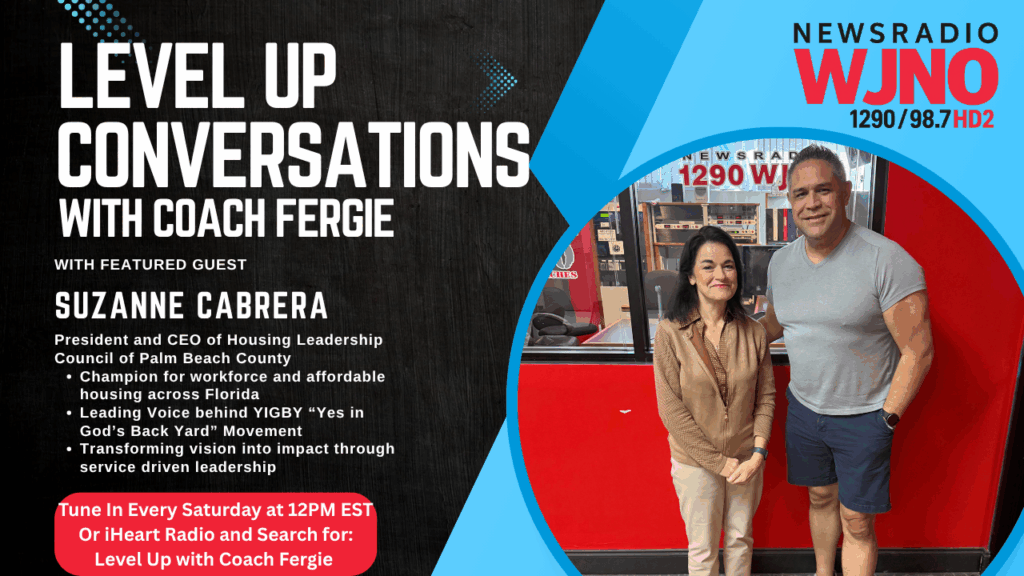
Suzanne Cabrera is the President and CEO of the Housing Leadership Council, a nonprofit coalition of business, civic, and community leaders dedicated to expanding workforce and affordable housing across Palm Beach County. A tireless advocate for housing reform, she has served as Chair of the Florida Housing Coalition and continues to speak at local, state, and national levels. Her leadership has been instrumental in advancing initiatives like Florida’s YIGBY—“Yes in God’s Backyard”—law, empowering faith-based organizations to use their land to create affordable homes and address the state’s housing crisis.
Coach fERGIE’S tOP 5+ Knowledge Nuggets and Take-Aways
- Faith-based leadership changes communities. When spiritual conviction meets action, transformation follows. ✨
- Partnership over politics. Great things happen when business, government, and faith work together. 🤝
- Leadership is local. You don’t need a title to make a difference; start in your own backyard. 🏡
- The best leaders simplify the complex. Cut the red tape, clear the noise, and focus on real impact. ✂️
- Affordability is not charity—it’s community infrastructure. Helping people live where they work strengthens everyone. 🧱
- Legacy outlives leadership. Projects like YIGBY remind us that service leaves footprints long after titles fade. 🕊️
Recommended Resources – Hover and Click
Please Consider Supporting the 988 Suicide and Crisis Hotline
- 🔹Valuable Time-Stamps 🔹
- 🕒 00:02:15 – Leaders Don’t Wait – Taking action without permission builds momentum.
- 🕒 00:05:40 – $23 Million Federal Grant Win – Moving forward boldly creates results.
- 🕒 00:16:10 – YIGBY Explained – Turning faith-based land into affordable housing.
- 🕒 00:18:45 – 101 Units of Hope – Church builds sanctuary with senior housing above.
- 🕒 00:25:10 – Faith in Motion – Collaboration and courage drive community change.
You Can Find Out more About HLCPBC and Contact Suzanne Here:
Phone: (561) 653-4107
Email: scabrera@hlcpbc.org
Artwork by Dylan Allen
Videography by Aubrey Aerials Marketing, LLC
Speech Transcript
Brian Mudd: [00:00:00] Are you ready to level up? Do you wish to live a life of options and not obligations? You’ve come to the right place? Thank you for stopping on by to hear knowledge nuggets from Coach Fergie and his top tier guest to help you lean into your ultimate human potential. Now, let’s level up with Coach Fergie.
Coach Fergie: Welcome back to another powerful edition of Level Up Conversations with Coach Fergie. With Time to Shine Today coaching. I’m your host, Scott Ferguson. Blessed to be your gap coach specialized in. Performance mental conditioning, working with business leaders, entrepreneurs, entertainers, athletes, C-Suite and students to help them bridge their success gap, deliver life of options and not obligations On this platform, we are soaked to bring you high performers who are not just chasing an attaining success but redefining it through, providing above and beyond service. <<READ MORE>>
Coach Fergie: Welcome back to another powerful edition of Level Up Conversations with Coach Fergie. With Time to Shine Today coaching. I’m your host, Scott Ferguson. Blessed to be your gap coach specialized in. Performance mental conditioning, working with business leaders, entrepreneurs, entertainers, athletes, C-Suite and students to help them bridge their success gap, deliver life of options and not obligations On this platform, we are soaked to bring you high performers who are not just chasing an attaining success but redefining it through, providing above and beyond service. <<READ MORE>>
And so little quick knowledge nugget this week squad once you to really kinda lean in with this. I was working with one of my executive coaching clients recently, a brilliant leader. With the title, the team, and the talent, but she was stuck, not because she lacked skill, [00:01:00] but because she was waiting for someone else to give her the green light.
She had the plan mapped out, but wouldn’t move until the board or her boss said, go. I reminded her, I’ll tell what I, I’ll remind you. What I kind of told her is that leaders don’t wait for permission. Leaders move. Permission is comfort disguised as patients. It’s fear hiding behind strategy, but real Leaders act with clarity, not certainty.
They take the first step before it’s perfect. They adapt in motion, they own the outcome. A few weeks later, that same client started leading with boldness, making calls, empowering their people, and setting the tone. And guess what? The organization started following our energy instead of waiting for direction.
You don’t build momentum by waiting. You build it by moving. Every great movement in history started with one person saying, why not now? Whether it’s launching a mission, starting a business, or reshaping an entire community, like we’ll hear from my guests today. Progress belongs to the ones who act. You want confidence?
Earn it through action. You want respect? Build it through service. You want change, lead it. So today, stop [00:02:00] waiting for the perfect timing, the perfect plan or the perfect applause, the permission slip you’ve been waiting for. You just wrote it yourself. Let’s get after it. And so. Squad buckle up today ’cause we’re leveling up with a true change maker in the flight for affordable housing and community growth.
My guest, Suzanne Cabrera, is the president and CEO of the Housing Leadership Council of Palm Beach County, a powerhouse coalition of business, civic and community leaders who are on a mission to make sure the people who serve and build our communities can actually afford to live in them. Since taking the helm, Susan has become one of Florida’s most respected and relentless advocates for housing reform.
She served as the chair of Florida Housing Collo Coalition, and she doesn’t just talk policy, she drives it. Right now, Suzanne’s leading the charge behind an innovative movement called Ybe, which is yes, in God’s backyard, a groundbreaking new law that empowers faith-based organizations to turn unused land into affordable homes for working families.
This isn’t just about zoning, it’s about hope, opportunity, and community transformation. Suzanne speaks truth to power at local, state, and national [00:03:00] levels, and she’s proof that when purpose meets persistence. Real change happens. So get ready to take notes, get inspired, and learn how collaboration, leadership, and a little faith can turn vision into homes and dreams into reality.
So you can learn more about our work@hb.org. That’s hlc pb.org. And following the Housing Leader Council on LinkedIn and Facebook, housing Leader Council of Palm Beach County. And Suzanne, which I have to also mention is my awesome PR person that feeds clients Here she is the mother of Kirsten’s. Uh, awesome son, Alex.
Yeah. And so just pleasure. And you have a daughter that serves in the military, in the Navy, which is the greatest service in the world. I do. Yeah.
Suzanne Cabrera: Right. Go Navy.
Coach Fergie: That’s right. So you’ve built like action or you know, or oriented coalitions, like what you’re, what you’re at right now. Right? Bring them together with civic, nonprofit, government leaders.
Like, I wanna just hop into kind of the toughest challenges that you’ve kind of had kind of. As you’re rolling this out, and we will [00:04:00] get into Ybe here in just a little bit. Sure. I wanna know a little bit about you and some of the toughest challenges you’ve kinda run up against.
Suzanne Cabrera: Well, housing is always difficult.
People say affordable housing and oxymoron in Palm Beach County. It’s just really a challenge. So true.
Joel Malken: Yes.
Suzanne Cabrera: Very expensive land and we have to get, and we’re built out. We’ve got nowhere to go. We can’t build in the ocean and we’re built out north, south, and. To the west, we can’t really do too much with environmentally.
And so it’s really a challenge to do something with what we have, and that’s where we’re trying to get creative, find new locations, new partnerships, and really work to make what we do more impactful and effective.
Coach Fergie: Love that. And so one of your major achievements is securing over 50 million in grants and awards for housing development.
So what lesson or process would surprise most people outside of the field? What was the secret sauce for you being able to make that happen? Because I talked a little bit earlier about my coaching knowledge, like about action taking, because a lot of this [00:05:00] stuff, I’ll tell you what, in this county, you’ve gotta sometimes do something, ask permission later Yes.
Kind of thing. Right? But like, what, what was the lesson that you kind of took away from, you know, raising that kind of money and like getting out there and getting after it? And what kind of pushback do you kind of get?
Suzanne Cabrera: Well, people have a misconception that some of the biggest money we get is the hardest to get.
And actually a great example is the federal grant that, um, I helped write and people were thinking, oh, you’re never gonna get that federal grant. It’s back when we had, um, all the stimulus money. Mm-hmm. And we applied. And honestly, just going forward, not knowing any better. Typically nonprofits did not apply for those funds.
Steve Austin: Right.
Suzanne Cabrera: And they were like, no, um, that needs. To go to government people, they’ll do a better job with it. Well, we wrote the grant and we got the award, and we didn’t know any better. We just, as you said, moved ahead and didn’t worry about what HUD would do at every moment. Right. We just kind of went and not very challenging.
We had $23 [00:06:00] million to spend. Only three years to do it, which would seem possible in the government scenario. But we had a really good core of 12 nonprofits and we all worked together and just forged ahead and, and didn’t worry about things that never happened.
Coach Fergie: When you said 23 million that you had to spend?
Yes. And is that like allocated, earmarked as certain things only.
Suzanne Cabrera: Yes, this was all for housing. Housing. At that time we were buying, um, homes that were foreclosed and trying to revitalize and uh, we did a portion of Lake Forest, tried to create a tipping point in the city, and I think we did in a lot of blocks.
You can go down and we can point to the work we did. Sure. And had to be very, um, strategic about how we did that. If we couldn’t get, um, you know, at least a quarter of the neighborhood, half the neighborhood homes, we didn’t even go into that area, which was kind of discipline. For some, but we knew in the end it was gonna be about creating that momentum and getting the whole neighborhood revitalized.
Coach Fergie: But you also think like 23 million in Palm Beach County could be spent [00:07:00] pretty quick though too.
Suzanne Cabrera: Yeah, as well. I think the timing was the hard thing. ’cause there’s, so we still had to follow all the rules. They were like, you know, follow every single rule. Do what you have to do. But wait, if you don’t spend that money in three years, we’re gonna take it back.
Right. I never thought spending money would be the big challenge. That it’s right.
Coach Fergie: Hard. ’cause I’m sure that people might be having hands out in certain areas like called my area. My area. My area. Right. It
Suzanne Cabrera: was so difficult and that’s where we had to do what was really best for the whole community. Love and really find that.
Opportunities to really make the biggest impact.
Coach Fergie: Do the politicians from the area kind of come out and lobby you for some of that money to be like, Hey, this is a, we want a beautiful beautification project here with like some different houses? Because I, I’m in real estate’s. My thing, you know, I grew up, I’ve been a, you know, a licensed agent since 1999.
I, you know, I’ve invested, I have over 80 properties under my portfolio and stuff like that. So, but like. I know that I would be like, Hey, you know, can we move [00:08:00] some of it this way into the neighborhood? I might have bought a rental in and made it a little bit nicer. Like, are you getting people, politicians, lobbyists kind of coming at you for some of that?
De Niro.
Suzanne Cabrera: Yeah, I think it, well actually the partnerships and I think that’s what we really are excited about, that um, if we can create a win-win for everybody and the things we can do for developers are things like helping them get more density, helping push back. We get a lot of nimby, not in my backyard.
Everybody wants affordable housing, workforce housing, but they don’t want it near them. So we really have to do a job of explaining. Who their neighbors will be and that, you know, you shouldn’t be upset about the teacher or the postman or whoever’s gonna move in there. So it’s a lot of education, but that when we find a position where it’s a real win-win for everybody, that’s when we know we’ve done our
Coach Fergie: job.
Absolutely. So many people. You know, think that housing issues come down to dollars like we, we, we’ve been talking about a little bit, but you’ve highlighted also regulatory and [00:09:00] cultural barriers too. Like what’s the biggest non-financial obstacle holding communities back right now?
Suzanne Cabrera: Well, it can be a lot of things in Palm Beach County.
It’s finding the appropriately and, and then the regulations you have to go through are, are just incredible. The hoops you have to jump through. Sure. And that’s why we really push to try to make it easier or make it easier for the county municipalities to do what. They need to do as far as they want more affordable housing, and they just need to find a way to get it.
And then I think the pushback, people are afraid of the unknown or we don’t know what the problem is, but we try to get a new development in area and I found it so helpful to sit down with the people who have worries about it and find out what their concerns are. And a lot of ’em are valid traffic, always.
What can we do for traffic? Can we add a lane? Can we show that, you know, it’s not really gonna increase traffic. I know in one area they didn’t want. A 20 unit housing unit, but they were okay with a 24 hour gas station. I showed them the [00:10:00] traffic for that and they’re like, oh no, give us the housing please.
Yeah, that’s
Coach Fergie: great that you, that you’re able to do that. Yeah. Like you really kind of flip the script on ’em and say, listen, you know, this is, have we thought about this? So how about workforce housing and affordable? Like I hear that and that even myself, I’m not exactly up to snuff on exactly what the difference is between those two.
Is there a distinction between like workforce and affordable in Palm Beach County
Suzanne Cabrera: that is so frustrating? Honestly, the only difference is where we get the financing from.
Steve Austin: Okay.
Suzanne Cabrera: And that’s something where there’s state tax, credit, money, and other money where they call it affordable. And you have to be at a certain income level to access that money.
Then workforce is, uh, anything above that. And we find people fall into both categories. You don’t really know. I wish we could just call it attainable housing or essential housing, but people easy to get
Coach Fergie: something like that. Yeah. Right.
Suzanne Cabrera: It’s just very frustrating. ’cause for the average person, it doesn’t make [00:11:00] a difference.
Right? I mean, teachers in Palm Beach County need affordable housing. Yeah. Not workforce housing. And so
Coach Fergie: do the servers and so do the. The people. ’cause I know, like right now, I’ve just noticed going to restaurants, it absolutely is not the same experience that I’ve had. And like I work in a service industry with, you know, coaching people or you know, even the real estate that I do, it’s like if I just treat people the way some of these people out there are treating people, I wouldn’t be in business.
And to find a great server at a restaurant right now Oh yeah. Is hard. And what it is, and I’m sure you can agree with this, is because they’ve all moved up to Martin County or somewhere they can afford.
Suzanne Cabrera: Absolutely. You know, and that is the frustration that people see. If you go into a restaurant, it seems like, oh, there’s a lot of empty tables.
But the problem is they don’t have the servers. Right. And the last thing they wanna do, I used to be a server going through college. Me
Steve Austin: too. Me too. Yeah.
Suzanne Cabrera: And uh, is see people that aren’t gonna get weighted on it. You wanna really frustrate someone and you find out, and I’ve talked to so many managers and they say, yeah, we just.
When we talk to people that can’t afford to live [00:12:00] nearby. Right. And the transportation, I mean, teachers
Coach Fergie: too, like you just said. Yeah. You know, like the, the education is paramount. For our children, but if we’re not gonna have the quality teachers in our area because they, if they can get a job in Martin County or you know, on the other side of the state or north in Ocala or something like that, they’re gonna go there instead of where we need them here where there’s a affluence and influence.
In our area, we wanna raise, you know, get those people.
Suzanne Cabrera: Oh, absolutely. Right. And teachers, especially, like a lot of them do go to Port St. Lucie, although that’s not too affordable these days. It’s getting up there. It is, yeah. Yeah, it really is. But we want ’em to stay in near school and be coaches and run the clubs and after a long day they just want to get home now.
And it, it would be nice if home was a little bit closer.
Coach Fergie: Yes. Yeah, exactly. Especially you if they have kids in school. You know, in the up there, and they have to drive here. It just gets Yeah. A little cumbersome for ’em. Right.
Suzanne Cabrera: We want our workforce close by. Yes. Especially our, our firefighters. Our policemen.
Yes. We really want everybody that. [00:13:00] Serves the community to be able to live in the community.
Coach Fergie: Absolutely. And squat. We’re gonna throw it to Steve Austin, my awesome sponsor with Rise Mortgage. Uh, but when we get back, we’re gonna kind dig into the yes in God’s backyard, the Ybe. That is a passion. Of our awesome sauce guest here, Suzanne, so stick around and we’ll see you in just a few.
Take it away, Steve.
Steve Austin: Thanks Scott. Happy Saturday everyone. This is Steve Austin with the Rise Mortgage Dynamic Team with your mortgage market recap for the week of October 27th. The cat and mouse game continues for the market as the Fed makes another. Cut of 25 basis points as expected, followed by Fed chair Jerome Powell’s press conference, which ended up hurting the mortgage bond market after he indicated that right now they aren’t sure if another rate cut in December will be done.
This comment was the opposite of what we were all hoping for in hearing. It caused a negative move in the market. So what does this mean? Big picture? Not much. Finishing the week, we are still seeing the market trading in the same range that we’ve been seeing since the beginning of October [00:14:00] as a whole.
Interest rates are still in a much better place for borrowers, so I don’t think we need to get too excited or worried about it and just continue this kind of slow pace waiting for the the right time to come. That’s it for this week. Have a great Halloween weekend everyone. This is Steve Austin, your branch manager.
NMLS 7 6 2 3 2 8. With the Rise mortgage Dynamic team, NMLS 1 6 0 4 6 6 3, and equal housing lender,
Joel Malken: are you looking to finance your dream home vacation getaway, or an investment property? The Rise Mortgage Dynamic team and company is here to help Steve Austin and his team, their expert loan advisors combine local knowledge with cutting edge technology to make your financing process efficient and seamless.
Whether it’s your first home or your next investment, trust Steve Austin and the Rise Mortgage Dynamic team and company to guide you every step of the way. Visit them today and experience the perfect blend of technology and personal touch. Steve Austin’s Rise Mortgage [00:15:00] Dynamic team. Your local experts in residential financing.
Call Steve today at (561) 352-9278. That’s 5 6 1 3 5 2 9 2 7 8 5 6 1 3 5 2 9 2 7 8 and MLS number 1 6 0 4 6 6 3.
Coach Fergie: Hey, hey. Thanks Steve. Thank you so much. So blessed to have you as our sponsor and. We’re back. We are here with my good friend Suzanne Cabrera. And Suzanne, yes. In God’s backyard. The Ybe program.
Y-I-G-B-Y. The initiative, is it passed in July, correct?
Suzanne Cabrera: Yes.
Coach Fergie: Okay. And it’s kinda shaken up how faith-based organizations can create housing solutions, which to me, I think that’s awesome. Yeah. Right. So how do you see this movement changing the future of affordable housing in Florida? What’s your big vision?
Like what are we seeing?
Suzanne Cabrera: The big vision is using a lot of unused land in Palm Beach County and throughout the state of Florida, [00:16:00] frankly, to create housing and also help a lot of faith-based communities that really need some income right now. Sure. I mean, that’s can be the ultimate win-win, and we’re having some of the deals here locally that are just working out so well for the church and then the developer gets land to build on.
I mean, when we talk about a win-win, it’s. Trying to work with faith-based communities.
Coach Fergie: So, so let’s say you have a church and you have some land on it, correct? Like Yes. The Raleigh Church. Yes. They own the land. They own the land and they’re able to get, uh, the, the zoning to put a house there. ’cause everyone knows there, there’s like an envelope if you’re looking at a piece of paper, the envelope that you probably looked at a lot of these where they would, could put a, a few houses.
So do. They, the, does the church own the, the property?
Suzanne Cabrera: Yes. And the, all these cases, I mean, they own
Coach Fergie: the property, but like the housing and stuff like that, I mean, they own it all right. They’re in control of it.
Suzanne Cabrera: Yes. They will own it all. Okay. Typically, they have a partnership if they’re trying to build housing on it.
Sure. Because churches aren’t [00:17:00] developers. Right. So we really have to find the experts and the developers are looking for pieces of land that can make things work. I mean, at the end of the day, they’ve gotta make. The whole deal, kind of pencil out and work. And this is something that really helps make those deals work and happen.
Love it. And then we can do things like increased density and um, really get some of the. Logistics taken care of that make buildings so expensive. 37% of the cost in one study of building a house is in all these rules and regulations. So we really have to reduce regulatory barriers and make the process simpler.
And actually that’s what Gig B does. And that’s why we needed the state to come in and pass the law, saying if you wanna pass this all administratively, you can. Right? If you wanna make it easier for churches, go for it.
Coach Fergie: The people in the houses, are they, are they expected to be members of the church?
Suzanne Cabrera: Oh, absolutely not.
Okay. And that’s the beauty of it, that, um, I know one deal we’re doing here in Palm [00:18:00] Beach County, there’ll be, um, the, um, sanctuary on the bottom floor. Okay. So the church gets their new sanctuary and 101 units above it for elderly Wow. And low income, and it just is. You know, for this church, it’s right in their, their guidebook.
The Bible says we gotta house people. Yes. And they were so thrilled when they were able to realize they could do something with their land. They’re on land that just has kind of one single family house on it right now. Right. And that is gonna turn into 101 units of beautiful new sanctuary, sanctuary for them and a stream of income.
Sure. And that’s just something that we see that, um, churches have are some of the biggest land holders.
Coach Fergie: Yeah, absolutely.
Suzanne Cabrera: In, uh, in the state. I
Coach Fergie: think it’s like McDonald’s and in churches or something like that. Yeah. It, it’s very, very high and.
Suzanne Cabrera: Typically they have land that they’re not using till it’s fullest potential.
And part of Ybe is that you can build housing on it. If it’s gonna be affordable housing, then you can change the use to residential [00:19:00] without like jumping over every,
Coach Fergie: I was just gonna say that you know it. And also the law that kind of passed. It’s optional, right? So, well
Suzanne Cabrera: it’s permissive. It gives municipalities and the county permission to use it.
For housing, residential housing.
Coach Fergie: Right.
Suzanne Cabrera: And then to skip a lot of the things that the state and local requires, the zoning and, and some of the, uh, regulations that are gonna make this very timely and very expensive. Okay. And that’s something that’s the benefit in the end is we’re really making the process simpler, quicker, and really getting down to the heart of it where we can put a little more density on it and, and really serve people.
You mentioned
Coach Fergie: density twice now. Can you educate me on the density.
Suzanne Cabrera: Yeah. And that is the big problem that we do have space, but when we try to build on it, we can’t get dense, the density, the number of people living in that area or that building any higher.
Coach Fergie: Right? For
Suzanne Cabrera: me, Manhattan density is the right density because we can do things like transit and we [00:20:00] can really make things affordable.
Coach Fergie: Sure.
Suzanne Cabrera: If we’re serving 101 people. Not one family household on this church property. We’re making a huge difference. And it really, I was gonna ask the economy of scale right. And, and everything, it’s worth it to have a, a bus come there and transport people around.
Coach Fergie: Right.
Suzanne Cabrera: If you have 101 units and not one family.
Coach Fergie: I love that, that, that’s what I was thinking is it’s gonna be a house. But I love that you said it’s multi-family. Yeah. It’s gonna be zoned for it. Um. You know, and it’s like, what I love is also it’s not just sitting on the shelf anymore. Yes. I mean, it’s actually out there. Do you guys have projects in the works right now that it, since it’s passed, we were ahead of our
Suzanne Cabrera: time in this.
Okay. And we were working on this before the law passed. In fact, that is something I worked with the state organization that wrote the legislation and help get it passed.
Steve Austin: Okay.
Suzanne Cabrera: And it was really going through the process here locally in some other places that we realized. This is great, but we could even make it better if we could make these changes.
Okay. And it was pretty [00:21:00] simple to put through, um, at the state level. And as I said, it just gave municipalities and the county permission to do what they’ve been telling us they wanna see, which is cheaper. Housing rates, cheaper rentals for people that really just can’t afford anymore. And that’s allowing this,
Coach Fergie: unless I read it wrong, the, the framework requires that like at least 10% of housing units be affordable.
Did I read that wrong? Because I mean, 10%, that’s another 90% out there. So how do you. Balance those affordability goals with the financial realities that developers are gonna face and stuff like
Suzanne Cabrera: that? Well, the good thing is most of the faith-based communities want to do a hundred percent affordable. Okay.
As I said, you look back to their, their guidebook, their manual. The Bible says, you know, I saw these people house ’em. Yes. And the one that’s 101 units. All affordable. So people get hung up on that. But honestly, having mixed uh, rate housing, having a variety of rents available in one place is actually great.
But in this case, they [00:22:00] all are gonna be affordable. And for seniors that’s so important, the people they’re targeting. But I think that, um, that is something that can really work out. And when you put. At the end of the day, put free land in the deal. That’s what makes the difference. And if we can go and say to the, the county increase this from 80 units to a hundred units, right?
That really brings the economy of scale in. Absolutely. And really makes it doable.
Coach Fergie: Are they thinking about ever putting like retail in it also?
Suzanne Cabrera: Oh, mixed use is absolutely awesome. And Oh, it is? Yeah. Okay. So it’s, and that’s typically when you have this, so you have a
Coach Fergie: church mixed use and then. Residential, you can
Suzanne Cabrera: have it all.
In this one case, they are gonna have their sanctuary, but they’re also gonna have some other things going on on the bottom floor that’ll make things more convenient for seniors.
Steve Austin: Love it. And
Suzanne Cabrera: I love that, that, you know, when you research a certain age, you don’t wanna have to go that far for a haircut or, or whatever else you’re getting done.
And we don’t have to worry about somebody getting behind the wheel that maybe, um, [00:23:00] shouldn’t be there. Right. Which can happen. Sure. In older folks, we just wanna make their life easier and better.
Coach Fergie: That’s awesome. And squat, I hope you’re. Seeing the blessing that my good friend Suzanne is really working on putting out there.
I mean, Isaiah 32 18 says, my people will live in peaceful dwelling places and secure homes and undisturbed places of rest. And that’s exactly what she’s doing. So thank you for like really spearheading this. This is that. That’s amazing. So place of worship is there. It is gonna be affordable. Is the people that are around the area, are they pushing back on this?
You know, ’cause it’s Palm Beach. Okay. And it’s like affordable might mean something. That’s again, they don’t believe in what I just read about it in Isaiah, right.
Suzanne Cabrera: We found out that, you know, meet people where they are, go talk to ’em. What are your concerns? So you are security. Okay, now it’s a big concern.
What can you do to make sure there’s more security? And typically they find out that they’re gonna have more security in this, you know, places have cameras now and, and having an occupied, [00:24:00] uh. Unit with a resident manager and a management company, you are gonna be a lot better off. So we just typically try to talk to people and find out, communicate right?
Just keep it open. Dialogue and landscaping does so much. If we can show them with all the new techniques now this is what your view will look like, and you’re not even gonna know what’s there in those cases. So we’ve been able to solve so many problems, but just telling them, you know. To you’re crazy and go away.
It’s not the way to handle it. ’cause they do have valid concerns. Sure, absolutely. And I think most of the time people know that a faith-based institution is gonna be a good nature.
Coach Fergie: Yes, absolutely. So what would then, if we, this scales right? Like what would success look like say in three years? You know, now Florida really activates the ybe.
Suzanne Cabrera: It’s gonna be just adding units across the state. I know in Palm Beach County, we already have several great projects going. Um, and the tricky part is scaling, and that’s something that we’re really working [00:25:00] on. Faith-based communities are not developers, but they don’t even know where to start. We had a, a great meeting with 150 faith-based entities, and they were like, you know, we’d love to do this.
We have land, but where, where do we start? Right? What do we do? So we’re starting actually a new, we’re calling it a cohort, a group of people that will work together for nine months to learn about the process and learn what you need to do with a developer to make sure you get what you need and they get.
Housing and, and really, as I said, it’s working to make it. Win-win. You are
Coach Fergie: the flexibility that you’re giving. You’re keeping the door open. Yeah. You’re having conversations. You’re not just saying, get outta here. This is law. Look at, we’re gonna push it through. You’re keeping the, the dialogue going, which is, is amazing what you’re doing.
So thank you for like really spearheading that. So I have to ask you if I can question that I ask all my interviewees, but like, how does Suzanne want her dash remembered? That little line in between your incarnation date and your expiration date, your life date, and your death date. There’s a lot that happens.[00:26:00]
And that dash like, how does Suzanne want her dash? Remember?
Suzanne Cabrera: I wanna do things that matter. Okay. I want to have made the world a better place. Well, I’m here on it and housing has always been so important. I worked at the Lord’s Place for many years. Oh wow.
Steve Austin: Wow. Okay.
Suzanne Cabrera: Really saw how easily people can just fall into a situation that they never, nobody ever grows up and says, gee, I wanna be homeless, I wanna be on drugs, I wanna have a mental illness.
They never, that’s something to do that,
Joel Malken: right? Yeah.
Suzanne Cabrera: And I think that this is such important work that we’re doing to make. Just happen and make sure that if you need an apartment for $500 a month, there will be one out there and there are some out there. Sure. Not enough though.
Coach Fergie: Right. And it’ll, it’ll gonna be happening, which is again, thank you so much.
How, how can we find you?
Suzanne Cabrera: Uh, basically, uh, we do a lot through the internet and actually it’s, uh, HLC. pbc.org,
Coach Fergie: right?
Suzanne Cabrera: Housing Leadership Council of Palm Beach county.org. And then we go out and speak, and I [00:27:00] love going out and telling people about the issue and really how we’re addressing it. Right now, I’m trying to recruit more faith-based entities.
You wanna find out about development? Do you have some land? I mean, this. Church never dreamed that their single home right could be their solution for their future. That’s beautiful. And the parish and, and churches are going through a lot of discernment process and they decided we need a sanctuary and, and this’ll fulfill another mission.
So I just love it when things come together like that.
Coach Fergie: Well this is just, this is just amazing squad. So any faith-based entities out there that have questions, you can reach out to the Housing Leadership Council of Palm Beach County at 5 6 1 6 5 3 4 1 0 7 Again. 5 6 1 6 5 3 4 1 0 7. Visit them@hlcpbc.org.That’s Hotel Lima, charlie papa bravo charlie.org. So thank you so much for coming on. Thank you. Brian Mudd for Producer Show. Kirsten, thank you for another rockstar interview and thank you to WJ and o. [00:28:00] Everybody out there have a safe and awesome weekend. Love your guts.
DISCLOSURE: I may be an affiliate for products and resources that I recommend. If you purchase those items through my links I will earn a commission. You will not pay more when buying a product through my link. In fact, I often times am able to negotiate a lower rate (or bonuses) not available elsewhere.
Plus, when you order through my link, it helps me to continue to offer you lots of free stuff. Thank you in advance for your support